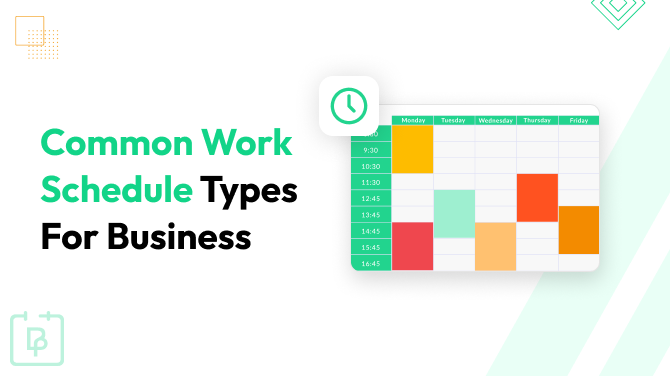
Thinking of how to provide your employees with the best schedule options yet stay effective as a business? Then you should definitely know all the options and understand whether they suit your business in its daily workload or seasonal changes.
To help you dig deeper into various work schedule types, we’ve prepared this full review and comparison of work schedule types that every business should know about. We’ll also touch on how you can automate many scheduling processes with software.
TL;DR. Work schedule types include full-time, part-time, flexible, shift work, split shifts, compressed workweeks, rotating, on-call, and seasonal schedules. Each offers unique benefits depending on business size, industry, and demand patterns.
Typical Work Schedule Types

Let’s illustrate various schedule types based on the length of working hours and industry specifics.
1. Full-Time Schedule
This is the most common work schedule globally – a fixed full-time schedule, typically around 40 hours per week across 5 days (often Monday to Friday).
Typically, this work schedule type includes:
- 35-40+ hours per week.
- 5 days per week, often 9-5 or similar.
- May include extra benefits depending on the company.
Example: Monday-Friday, 9:00 AM – 5:00 PM.
However, the exact pattern varies by region because of labor laws, culture, and dominant industries (e.g., in the US, labor regulations like the 40-hour workweek and overtime laws, and a large office/service economy with daytime operations are the main reasons for this schedule). In Southeast Asia, you will see a fixed full-time schedule with 6-day workweeks in some sectors.
2. Part-Time Schedule
Part-time schedules are most common where businesses need variable staffing, extended opening hours, or have seasonal demand. Labor laws, social benefits, and cultural norms also matter a lot.
Normally, part-time work schedules include:
- Fewer hours than full-time (often under 30-35 hours/week).
- Can be fixed or variable.
Example: Monday-Thursday, 10:00 AM-2:00 PM.
Hospitality, healthcare, and even education – all often involve part-time schedules. Personal services, e.g. services booked by appointment, often use part-time professionals.
For example, in retail, there is a very high use of part-time employees. Stores open long hours (evenings/weekends) and staffing needs to change throughout the day. It’s quite widespread in the US, United Kingdom, Canada, India, and Australia.
3. Flexible Schedule (Flex Time)
This is a more modern way for many areas – employees choose when they start and finish within limits. Usually, this work schedule type includes core hours that everyone must work. Flexible schedules are very common with knowledge work or output-based tasks, which is why it’s very common with freelance workers.
Moreover, it’s popular in industries, such as:
- Technology and software
- Marketing and creative services
- Consulting
- Media and design
- Research and education
Example: Work 8 hours anytime between 7:00 AM-7:00 PM.
Flex time work schedules are common in the Netherlands, Denmark, Sweden, Germany, United States and Canada.
4. Shift Work
If you are in the industrial sectors or 24-hour services that require continuous staffing, shift work may be required.
In this work schedule, work is divided into rotating or separate shifts to cover longer hours. Common shifts:
- Morning shift
- Afternoon shift
- Night shift
- Rotating shifts
Example:
- Shift 1: 6 AM-2 PM
- Shift 2: 2 PM-10 PM
- Shift 3: 10 PM-6 AM
Sometimes, even 24/7 operations are possible, which may provide higher productivity (facilities used all day) to a business. Flexible staffing during peak hours also makes sense for the business.
However, there are high risks for employees, such as sleep disruption and fatigue, higher risk of health problems (stress, heart issues), and work-life balance difficulties. Shift work is popular in transportation, hospitality, security, and emergency services in many countries from the US to China.
5. Split Shift
A split shift is a work schedule where the workday is divided into two (sometimes three) separate working periods with a long, unpaid break in between. It reduces labor costs during slow hours in the middle of the day and may provide very efficient staffing during peak demand, even though it may feel longer for workers because of the long gaps.
Example:
- 8:00 AM-12:00 PM
- Break
- 4:00 PM-8:00 PM
Businesses often require this type of shift in restaurants and cafés, hotels and hospitality, public transportation, and tourism services.
6. Compressed Workweek
A work schedule type called a compressed workweek means employees work their full weekly hours in fewer days (normally this takes working longer days or working on the weekend).
Common formats:
- 4×10 → 4 days, 10 hours each
- 9/80 schedule → 9 days over two weeks
This work schedule type may be common for technology and IT, engineering, government jobs, or manufacturing.
7. Rotating Schedule
Using this schedule type, employees rotate through different shifts or days. Unpopular shifts (like nights or weekends) are shared among employees instead of always assigned to the same people. For a business, a benefit is also great – you can run 24/7 without overburdening a single group of workers.
Example:
Week 1: Day shift
Week 2: Night shift
Some sectors, like healthcare and manufacturing, simply require 24-hour operations, so rotating schedules helps with continuous staffing.
8. On-Call Schedule
As its name suggests, an on-call schedule means employees are not actively working but must be available to start work if needed.
When a request, emergency, or urgent task arises, the on-call employee is contacted and must respond within a specified time. Such shifts are basically quick responses to urgent issues, but workers must remain near their workplace or be reachable.
9. Seasonal / Temporary Schedule
You can also hire employees who work only during specific periods of high demand (staff are hired or scheduled for short-term or peak seasons). Staff schedules often include flexible or extended hours during peak periods. Very popular in tourism and hospitality, retail, agriculture, and event management.
Let’s now put the main features of these work schedules into the comparison table for a quick review.
Work Schedule Type Comparison
| Work Schedule Type | Typical Working Hours | Benefits for Business |
| Full-Time Schedule | 35-40+ hours/week, usually 5 days | Predictable operations and easy workforce planning |
| Part-Time Schedule | Under ~30-35 hours/week; fixed or variable shifts | Easier coverage during busy hours |
| Flexible Schedule (Flex Time) | Employees choose start/end times within limits, often 8 hours/day | Higher employee satisfaction and improved productivity |
| Shift Work | Multiple shifts covering 24 hours (e.g., 6 AM-2 PM, 2 PM-10 PM, 10 PM-6 AM) | Covers peak demand periods |
| Split Shift | Two work periods in a day with a long break between | Lower labor costs during slow hours |
| Compressed Workweek | Full weekly hours in fewer days (e.g., 4×10 schedule) | Fewer operating days and reduced commuting |
| Rotating Schedule | Employees periodically rotate shifts or days | Fair distribution of shifts, continuous operations, and better staffing balance |
| On-Call Schedule | Employees are available outside regular hours if needed | Rapid response to emergencies, no need for full-time overnight staff |
| Seasonal / Temporary Schedule | Short-term or peak-season work | Easy scaling during peak demand |
How to Automate Schedules for Employees
If your business needs to manage multiple employees who need to combine various shifts, the right software can save you a lot of time. BookingPress is one of them, offering many automated tools for employee scheduling, appointment booking, and payment management.
BookingPress has a few great tools to manage scheduling for your shifts and employees:
- Individual staff accounts, where each employee can log in on your WordPress site, manage appointments, work with clients, generate booking links, and track or customize their schedule through a personal dashboard.
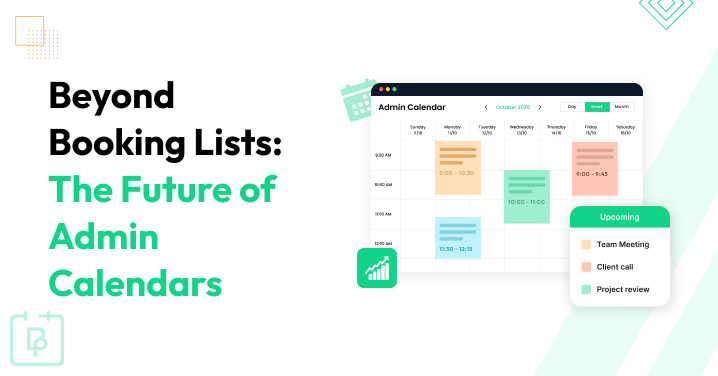
- Calendar-focused scheduling for your staff to view and manage upcoming bookings through a visual calendar with appointment statuses and details.
- Managers can configure daily working hours, breaks, holidays, and special days for each team member.
- You can assign specific services to qualified employees so that bookings are smartly distributed.
- Integration with popular calendar apps to get notified on new bookings that update the shift dynamically.
In reality, all those solutions help prevent overbooking, various scheduling conflicts and overlapping, and uneven workloads so that there is always the right staff member for each client.
It’s specifically created to serve salons, clinics, fitness studios, and consulting services, with many dedicated tools to manage large teams.
Concluding
Even though choosing the right work schedule for business might seem a logical task and most of the time, workflow usually suggests the best schedule. Still, there is room to better balance labor costs, customer demand, and operational coverage.
Especially in service-based industries, it’s easier to combine several of these schedules to have a more productive staffing throughout the day or season.
You May Also Like:


 14-day money-back guarantee