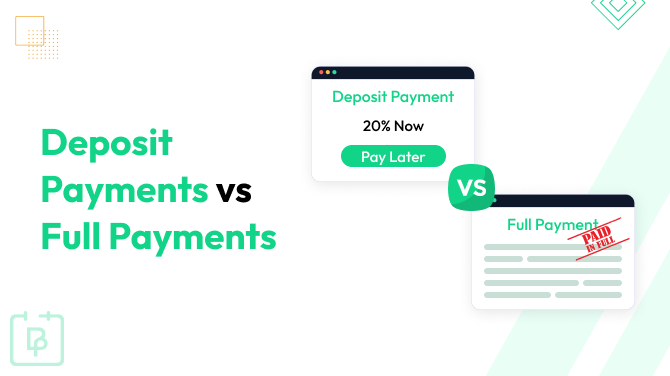
Deposit payments and full payments are two common ways to collect money for appointment bookings, but choosing the wrong one can quietly affect your service business.
If customers don’t pay in advance, they are more likely to cancel or not show up. If you ask for full payment too early, some customers will hesitate to book at all.
This is where most appointment-based businesses get stuck. They either deal with more cancellations or struggle with lower booking conversions.
And to be fair, deciding between deposit payments and full payments is not just about how you collect money. It directly affects:
- How serious your customers are.
- How full your calendar stays.
- How predictable your revenue becomes.
Keep reading to understand the difference between deposit payments vs. full payments, and decide which one is right-fit for your service business.
TL;DR: Deposits help you get more bookings but lowers commitment sometime, while full payments lowers cancellations as well as conversions by increasing serious customer commitment. Using both full and deposit payment methods with BookingPress is an excellent strategy to improve conversions while managing cash flow.
What Are Deposit Payments in Appointment Bookings?

Deposit payments in appointment bookings are upfront partial payments which are made in advance for confirming an appointment.
This deposit payment can be set as fixed or percentage.
You must’ve come across terms like “20% down payment”, “50% down” or “pay $100 ahead to confirm your slot or deal”. That’s exactly what we call deposit payments.
Rather than paying a full amount ahead, the customer pays a small portion during the time of appointment booking, and the remaining balance is paid later, mostly after the service is given.
Let’s say a service like a hair cut costs $100. Then you can ask for a $20 to $30 deposit during the booking process to secure the time slot.
Best of all, you can easily accept online deposit payment during the time of booking via 20+ payment gateways using BookingPress, an all-in-one WordPress appointment booking plugin.
For service businesses, deposit payments:
- Lowers no shows.
- Filters out non serious bookings.
- Keeps booking conversions high.
In other words, deposit payments strike a perfect balance between flexibility and commitment for your customers and clients.
What Are Full Payments for Appointment Bookings?

Full payment at the time of appointment booking means the customer must pay the full service amount ahead.
There is no pending balance. Customers pay 100% of the service cost online or in-person. After the payment is made, the appointment is fully confirmed.
Think of it like this. A hair cut service costs $100 in a salon. So, the customer simply pays the full $100 while booking the appointment, mostly online.
This model works best when you want certainty. Because customers have already paid in full, they are far less likely to cancel or miss the appointment.
For service businesses, taking full payments
- Reduces last minute cancellations.
- Secures guaranteed revenue.
- Makes payment management easy.
However, asking for full payment can sometimes lower booking conversions for new customers or higher priced services because customer trust plays an important role here.
Quick Comparison: Deposit vs Full Payments for Appointment Bookings
Don’t have time to scroll further? No worries. Take a look at the side by side comparison of full payments vs. deposit payments for appointment bookings.
| Aspect | Deposit Payments | Full Payments |
| Upfront payment | Pay a small part of the total. | Pay the full amount. |
| Customer commitment | Medium. | High. |
| No-show risk | Lower. | Very low. |
| Booking conversions | Higher. | Slightly lower. |
| Cash flow | Partial upfront. | Full upfront. |
| Business risk | Some risk remains. | Almost no risk. |
| Best for | Advance bookings, higher-priced services, businesses with frequent no-shows. | High-demand slots, low-cost services, businesses needing guaranteed revenue. |
| Payment follow-up | Balance collected later. | No follow-up needed. |
| Customer flexibility | More flexible. | Less flexible. |
The Hidden Trade-Off Between Deposit and Full Payment

At first, this choice looks simple but every payment model comes with a trade-off.
Deposit payments make it easier for customers to say yes. The lower the cost, the lower the hesitation. So, you get more bookings. But since customers haven’t paid in full, their commitment is lower too. Some can cancel, reschedule or not show up at all. You gain volume but not every booking turns into revenue.
Full payments work in the opposite way. When customers pay 100% of the amount before the service, they are more committed than ever because they paid the full amount already. This leads to very low no show rates and more predictable revenue. But, again, asking for full payment creates hesitation for new customers or higher priced services. This is simply the matter of trust. You get fewer bookings, but almost all of them are serious.
Now some businesses try to avoid this choice by not taking any payment upfront. While this keeps the booking process simple, it also creates the highest risk. When there’s no risk, people don’t care. The same way when there’s no money involved, customers naturally take the booking less seriously.
Another way is to make payment in advance optional by letting customers choose whether to pay now or later. It may sound fair but can lead to inconsistent behavior as some customers commit and others don’t. This will make your calendar less predictable.
Thus here’s a simple way to think of it:
| Factor | Deposit Payments | Full Payments |
| Customer risk feeling | Lower. | Higher. |
| Commitment level | Medium. | High. |
| Booking friction | Low. | Higher. |
| Cancellation chance | Moderate. | Very low. |
| Cash comfort (customer) | High. | Lower. |
| Trust required | Moderate. | High. |
| Best use case | New customers and high value services. | Repeat customers and high demand slots. |
At the end of the day, there is no perfect option here. The goal is not to remove risk completely, but to choose the level of risk your business can handle. After you understand this, the right payment model becomes much easier to choose.
How to Decide Between Deposit and Full Payment

There’s no single “best” option here. The right choice is on how your customers behave and how your business works.
Ask yourself the following questions and you’ll find the answer yourself:
1. How Likely Are Customers To Cancel?
If you see more:
- last-minute cancellations.
- no-shows.
- “maybe” bookings.
Go with deposit payments or full payments Why? Because once money is involved, customers take the booking more seriously.
- Average cancellation rate? → Deposit is enough.
- Too many no shows? → Full payment is needed.
2. How Expensive Is Your Service?
As we all know, the price of services always affects customer decisions.
- Higher priced services → Customers hesitate to pay in full.
- Lower priced services → Easier to collect full payment.
The logic is simple here:
- Expensive service → Deposit payments.
- Lower priced service → Full payments.
3. How Far In Advance Do People Book?
Timing matters more than most businesses think. If the appointment is made days or weeks in advance, there are more chances it’ll be cancelled.
Same day or last minute bookings → Lower chance of cancellation.
Thus, here’s what to do:
- Advance bookings → Deposit payments.
- Last minute bookings → Full payments.
4. Do Customers Already Trust Your Business?
Trust is the most important factor for service businesses and it changes everything.
New customers are always less willing to pay in full because they still don’t trust you. Yet on the other hand, repeat customers will be more comfortable paying ahead because they know and trust your business.
That’s why the best approach is:
- First time clients → Deposit payments.
- Returning clients → Full payments.
5. What Matters More: Bookings Or Certainty?
This is the real decision.
So, go ahead and ask yourself:
Do I want more bookings, even if some cancel? Or do I want fewer cancellations, even if bookings drop slightly?
Your answer decides the model:
- Want more bookings → Choose deposit payments.
- Want more certainty → Choose full payments.
Remember you’re not just choosing how to collect money but how your customers behave after booking.
A small change in payment structure can:
- Lower cancellations.
- Improve commitment.
- stabilize your daily schedule.
Choose the payment model that fits your business reality, not just what others are doing
Best Strategy for Appointment-Based Service Businesses
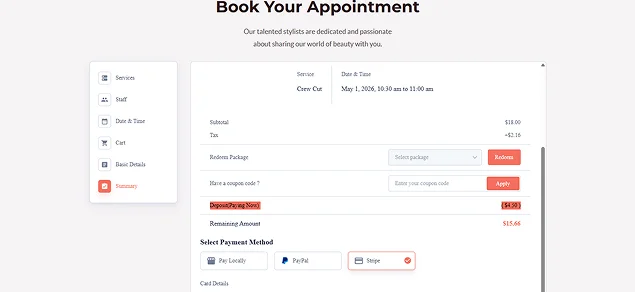
If you’ve made it this far, one thing should be clear:
There is no single “perfect” payment model.
The smartest service businesses use a hybrid strategy based on customer behavior, service type and booking context.
The Hybrid Approach (What Actually Works in Real Businesses)
No need to force customers on one option for every booking when you can combine both:
- Deposit payments for flexibility.
- Full payments for commitment.
This gives you the best of both worlds:
- Higher booking conversions
- Lower cancellations
- More predictable revenue
- Better cash flow.
- Wider customer reach.
If you want a simple way to apply everything we discussed, use this decision framework:
| If your business has… | Use this model |
| High no show rates | Full payment |
| Moderate cancellations | Deposit payments |
| Premium / high priced services | Deposit payments |
| Low cost quick services | Full payment |
| New or first time customers | Deposit payments |
| Repeat and loyal customers | Full payment |
| Advance bookings (days or weeks ahead) | Deposit payments |
| Last minute or same day bookings | Full payment |
| Limited availability or peak time slots | Full payment |
| Need higher booking conversions | Deposit payments |
| Need more predictable revenue | Full payment |
Most businesses fail here because they choose one model and stick to it. But customer behavior is not fixed so your payment strategy shouldn’t be either.
The real advantage comes from adapting your payment model to how your customers book, pay and behave.
That’s how you turn a simple payment decision into a real business growth lever.
Final Verdict
When it comes to deposit payments vs full payments for appointment bookings, there is no single best option. Thus the smartest way is to use both based on your service business.
With WordPress appointment booking plugins like BookingPress, you can accept online payments, full and deposit, via 20+ payment gateways like PayPal, Stripe, Authorize.Net, Mollie, WooCommerce, and many more.
Remember the right payment model is the one that fits with your customers behavior and how your service business works.
Related articles:
- How to Integrate Online Payment into Fitness Studio Website
- How to Set Up Multi-Service Booking in BookingPress
- How Online Booking System Will Help You Increase Revenue
FAQ
Deposit is generally the better mode of payment for service businesses (spa, salon, or clinic) because they lower no-shows, secures revenue and improves cash flow.
Deposits via PayPal and Stripe are mostly better payment options for online appointment bookings. And the best part is tools like BookingPress lets you accept online payment, full or deposit, via 20+ payment gateways.
BookingPress is the best appointment scheduling system that turns your WordPress website into a complete online booking system.This plugin comes with an exclusive set of 60+ premium addons and 20+ payment gateways for accepting on-site and online payment, full or deposit.
The point of taking a deposit for an appointment booking is to protect your service business from revenue loss due to last-minute cancellations and no-show ups. Because when pay in advance is involved, customers think twice before cancelling.
A deposit is a small portion of the total service amount which is taken as a security or part-payment towards final balance. A booking fee, on the other hand, is non-refundable nor acts as a part of the final amount. It’s just the cost of using the booking platform’s services.
 14-day money-back guarantee